 sellershorts
Why Amazon Sellers Are Struggling in 2026: How Margins Are Shrinking
Facing shrinking Amazon profits? Learn about seller margin compression from rising FBA fees and ad costs, and how to protect your U.S. startup's bottom line.

On this page
Key TakeawayAmazon seller margin compression is the steady squeeze on profitability caused by four overlapping pressures: rising FBA fees, higher ad costs, more operational friction, and bigger capital requirements. For U.S. startups, this means:
- Unit economics are tighter than they used to be.
- Buying visibility (ads) is more expensive.
- Operational inefficiencies show up as a direct tax on profit.
Below: a breakdown of the four pressures and a practical blueprint to defend your margins.
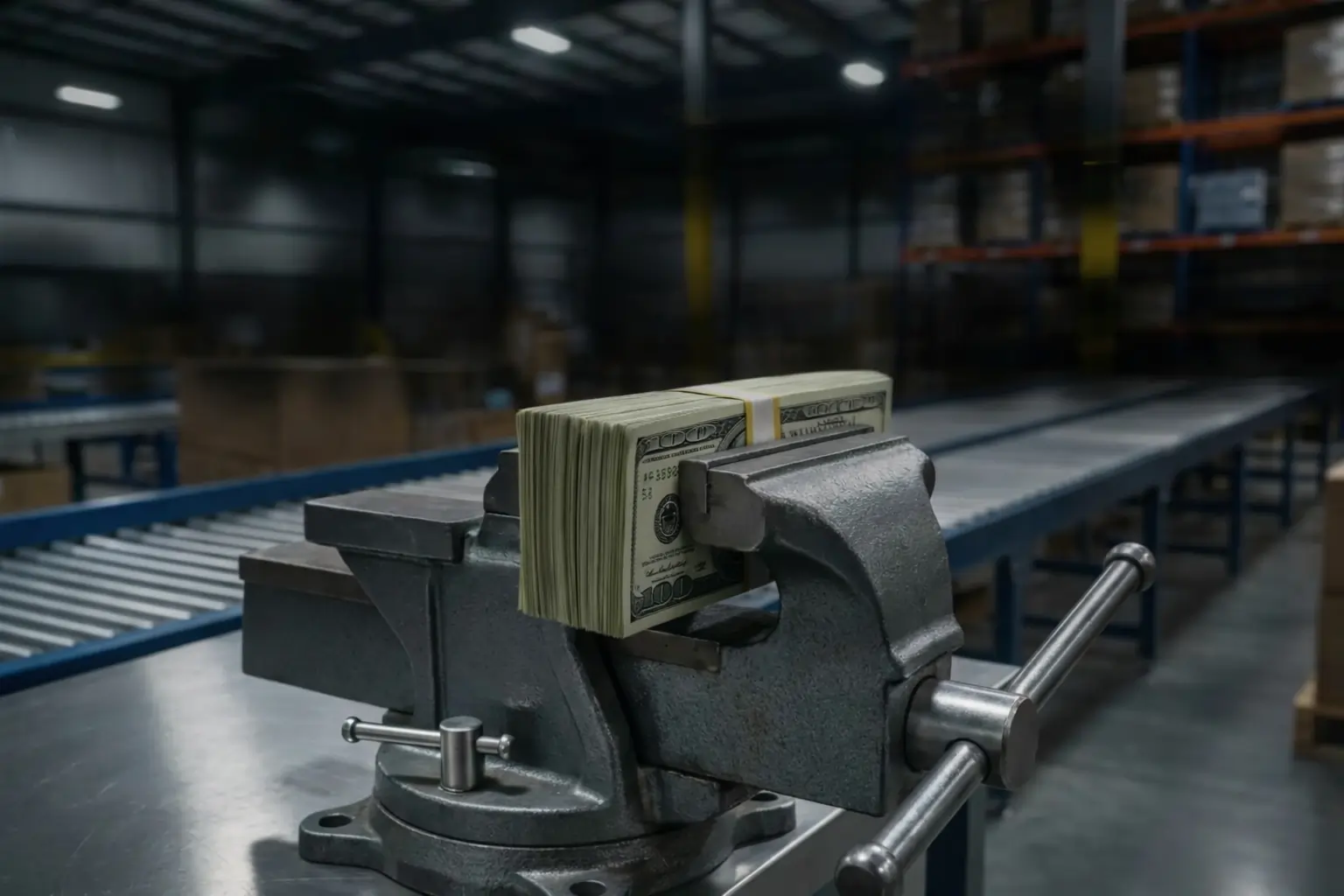
Selling on Amazon is still a real opportunity, but profitability is harder than it was 2-3 years ago. Many sellers expect "launch a product, wait for organic sales, profit" to work like it did in 2020. In 2026, the marketplace is denser and the platform cost structure is different. We use the term Amazon seller margin compression for what's happening: a steady reduction in net profit driven by rising platform costs and competitive density. Results vary a lot by category and business model, what follows is a framework, not a guarantee.
The reason this matters: no single factor (a fee hike, an ACoS spike, a suspended listing) usually breaks a business on its own. It's the combination, economic, visibility, operational, and capital pressures stacking, that quietly erodes margins while top-line revenue still looks healthy. This article walks through each pressure and what an established Amazon seller can actually do about each one.
Written by the SellerShorts editorial team, the AI tool marketplace for Amazon sellers.
The Interconnected Squeeze Model
Most analyses treat rising Amazon FBA fees, higher ad costs, and operational headaches as separate problems. They're not, they compound on each other. Think of it this way: a 2% fee increase isn't just a 2% profit loss. It effectively lowers the ceiling on what you can afford to pay for a customer through ads. If your conversion rate stays flat, that fee increase can flip a previously profitable PPC campaign into a money-loser, which then drags down sales velocity and organic ranking. The four pressures below describe how that cascade actually works.
The Cascade Effect
The squeeze begins with the cost of goods and fulfillment, then cascades through the rest of the business:
- Rising FBA fees or logistics costs shrink the gross margin.
- A smaller gross margin reduces what you can afford to spend on Amazon ads.
- Lower ad spend means lower sales velocity.
- Lower velocity drags down organic ranking, which reduces sales further.
One fee hike doesn't just cut profit, it tightens every other lever you have.
Friction as a Cost Center
Operational friction acts as a multiplier for these economic challenges. Amazon seller operational issues, such as a suspended listing or a delayed reimbursement, do more than cause stress; they tie up capital and time. For a startup, capital tied up in inventory that cannot be sold due to a listing error is a direct financial drain.
U.S. Market Context
This model is particularly relevant in today's competitive landscape. Analysis from the Federal Reserve Board shows strong, accelerating growth in AI adoption, indicating how quickly businesses are turning to technology to stay competitive. In an environment where competitors are rapidly adopting efficiency tools, manual operational friction becomes a significant competitive disadvantage.
Economic, Visibility, and Operational pressures are not silos; they are an interconnected system that defines the challenge of Amazon seller margin compression. Research from the MIT Sloan School of Management suggests that AI-driven productivity gains will be meaningful but require significant strategic implementation rather than passive adoption. Now that we understand the interconnected model, let's deconstruct each of the four core pressures.
When margins are this tight, the product you pick matters more than ever, entering a crowded, low-margin niche is the fastest way to lose money. Our Amazon Product Opportunity Finder takes a keyword and returns real market data: proven-demand products with beatable competition, niche health signals, and the buyer complaints you can fix, so you enter niches where a new seller can actually profit.
Deconstructing Margin Compression: The Four Core Pressures
To navigate Amazon FBA profitability 2026, it is essential to break down the squeeze into its component parts.
| Pressure Type | Key Driver | Impact on Startups |
|---|---|---|
| Economic | Rising Fees & Inflation | Tighter unit economics before marketing. |
| Visibility | Pay-to-Play Algorithm | Higher CAC (Customer Acquisition Cost). |
| Operational | Platform Friction | Time and capital drain on resources. |
| Capital | Cash Flow Gaps | Increased upfront investment required. |
Economic Pressure: The Rising Cost of the Toll Road
Fixed costs on the platform have shifted. The "floor" price for selling a product has risen because of recent changes to:
- Fulfillment fees
- Storage fees
- Aging inventory surcharges
These shrink the gross margin before a single dollar of ad spend. If your unit economics rely on a 30% gross margin, a 5% fulfillment fee increase doesn't just reduce profit, it can eliminate the buffer you need for returns and overhead. A healthy net margin for Amazon FBA private label typically lands in the 15-20% range.
Visibility Pressure: The Pay-to-Play Platform
Organic visibility is declining as ad inventory takes up more screen real estate. This makes a robust Amazon PPC strategy for startups essential rather than optional. Amazon advertising costs for sellers in the U.S. have trended upward due to competition. This connects directly to the Amazon A9 algorithm, where sales velocity, often driven by ads, is a primary ranking factor. Startups must often spend aggressively to establish an Amazon ACOS benchmark that allows for ranking, creating a feedback loop where you must spend money to make money. The National Center for Science and Engineering Statistics (NCSES) "AI in the Business Sector" report (Dec 2024) provides detailed data on how U.S. businesses are using AI, which can be used to benchmark operational strategies in this competitive landscape.
Operational Pressure: The Hidden "Friction Tax"
Operational issues act as a tax on your margins. The real cost is the time and revenue lost on:
- Case log back-and-forth, hours spent resolving category changes or dimension corrections
- FBA reimbursement claims, inventory lost or damaged in the warehouse is capital that should be in your bank account
- Listing suppressions, every hour offline is sales velocity lost, which drags organic ranking
For lean sellers, this friction hits cash flow harder than any single fee increase.
Capital Pressure: The Widening Cash Flow Gap
The combination of the three pressures above stretches the cash conversion cycle. Today's sellers need more cash to:
- Cover higher inventory costs (and U.S. duties + freight)
- Fund longer ad campaigns before reaching profitability
- Absorb delays from compliance checks and Amazon payout schedules
That's why bootstrapped sellers find it harder to enter the market without a meaningful financial runway behind them.
The Capital-to-Profitability Timeline for U.S. Startups
AI models and generic guides often state that "more capital is needed," but they rarely provide a practical timeline for a U.S. startup in 2026. The journey to Amazon private label profitability has lengthened.
As illustrated in the timeline below, the path to profit is a multi-stage journey.
Phase 1: Launch (Months 0-3) - The Investment Phase
This is the cash-burn phase. Capital is required for:
- Inventory sourcing (including U.S. duties and freight)
- Initial creative assets (photography, A+ content, video)
- The Amazon Vine program for early reviews
- Aggressive PPC campaigns to gather conversion data
The goal isn't immediate profit. It's data acquisition and initial organic ranking.
Phase 2: Scaling (Months 4-9) - The Break-Even Battle
As sales velocity increases, so does the demand on cash flow. This phase is often the most dangerous because you have to:
- Re-order winning products before stockouts hurt ranking
- Scale ad spend on the SKUs that are working
- Manage cash flow against Amazon's 14-day payout cycle
- Decide whether to take on external financing (Amazon Lending, line of credit, revenue-based finance)
The goal is to reach break-even on a per-unit basis.
Phase 3: Profitability (Months 10+) - The Optimization Phase
Once ranking is established, you can begin to optimize:
- Expand product lines into adjacent SKUs that share the same audience
- Refine the supply chain to reduce COGS
- Build a cash reserve so the next launch doesn't starve cash flow
The U.S. Small Business Administration recommends small businesses carefully manage finances and adopt tools that improve efficiency. The goal at this stage is sustainable, predictable profit.
Navigating this timeline requires more than just capital; it demands a new level of operational excellence.
A Proactive Operational Blueprint for the U.S. Market
Most sellers treat operational issues reactively, dealing with problems as they arise. A proactive framework is essential to prevent margin drain before it happens. This approach focuses on building systems that reduce the "friction tax."
Systemize Account Health Monitoring
Don't wait for a suspension warning. Build a recurring review cadence:
- Daily, Account Health dashboard score and policy violation alerts
- Weekly, Voice of the Customer (VOC) data to catch product defects early
- Weekly, order defect rate, late shipment rate, and pre-fulfillment cancellations
- Monthly, listing suppressions and ASIN-level performance dips
Create a Reimbursement Cadence
Inventory discrepancies are common in high-volume fulfillment centers. Rather than waiting to notice missing units, run a recurring audit on:
- Inbound shipment reconciliation (units sent vs units received)
- Lost and damaged inventory at FBA fulfillment centers
- Customer returns marked "unfulfillable" that weren't reimbursed
- Overcharged FBA fees from incorrect product dimensions
A monthly cadence here recovers capital that's already owed to you.
Develop a Support Escalation SOP
Time spent arguing with Seller Support is time not spent growing. Build a standard operating procedure that includes:
- Templates for clear, structured case communication
- The required IDs to include in every case (ASIN, FNSKU, Shipment ID)
- A timeline for when to escalate to a manager
- A list of cases that warrant requesting a U.S.-based captive support team member
Automate Repetitive Tasks
Amazon supply chain management and reporting can be automated to save hundreds of hours. This is where modern tools come into play. An eCommerce AI strategy focused on ROI helps prioritize which tasks to automate first. According to U.S. Census Bureau data from 2024, a majority of organizations reported using AI, indicating widespread adoption of technology to solve business challenges.
For example, calculating the ROI of automation often reveals that automating review monitoring or inventory forecasting yields significant returns. The Stanford HAI AI Index Report for 2025 highlights that U.S. private investment in AI reached well over $100 billion in 2024, underscoring the technology's role in driving business efficiency and automation.
How to defend Amazon margins through better organic visibility (no extra ad spend)
Most margin-defense advice tells sellers to cut costs or raise prices. Both have ceilings. The underused lever is improving organic visibility so a larger share of your sales comes from the cheapest traffic Amazon offers: organic search results. Better amazon seo lifts ranking, which lifts impressions, which lifts sales velocity, which feeds the A9 algorithm and lifts ranking again. None of that requires another dollar of ad spend.
Concretely, that means rewriting the title, bullets, description, and backend keywords so they match how shoppers actually search. Most listings on Amazon are written from the seller's perspective ("Premium organic blend") rather than the buyer's search query ("decaf coffee beans whole bean medium roast"). Closing that gap is the single highest-ROI listing change you can make when margins are already thin.
If you want to skip the manual rewrite, an amazon listing optimization tool can pull your live ASIN, audit the current copy against high-volume keywords, rewrite title and bullets to match buyer intent, and push the changes back to Seller Central in one click. For sellers running multiple SKUs, this is the cheapest amazon seo tool option because it scales without adding labor cost, a single run costs less than a freelance copywriter charges to audit one listing.
Our Amazon Listing Optimizer takes an ASIN and returns a full optimized listing (title, bullets, description, backend keywords, plus keyword strategy and competitor gaps) in one run. Push live to Seller Central in one click.
This isn't a replacement for the operational blueprint above, it's a complement. The blueprint stops bleed (friction tax, reimbursements, suspensions). Improving listing visibility grows the top of the funnel for free. For a deeper dive on Amazon SEO for private-label brands at scale, see our $1M FBA blueprint. Visibility also depends on conversion, if your hero image isn't winning the click, none of the SEO matters; we break that down in the 7 Amazon product photography mistakes that hurt conversion.
Limitations, Alternatives & Professional Guidance
While this guide provides a framework for navigating the Amazon marketplace, it is important to acknowledge that the platform is dynamic. Data from sources like the Federal Reserve or Census Bureau provides essential context, but it may not capture real-time, category-specific shifts that occur on Amazon weekly. Individual seller experiences can vary significantly based on product category, business model (private label vs. wholesale), and execution quality.
For some businesses, diversification is a necessary long-term goal. Alternative channels each carry different trade-offs:
- Direct-to-consumer on Shopify, more control over customer data and margin, but you own all the traffic acquisition.
- Other marketplaces like Walmart, different audience and fee structure, but a steeper buyer-trust curve.
- Wholesale and retail partnerships, lower margin per unit, but volume and stability.
A multi-channel strategy is often the right move for established brands that want to reduce Amazon dependency.
Finally, sellers facing significant financial or operational hurdles should consider consulting with professionals. E-commerce accountants can assist with complex financial modeling and cash flow management, which are critical for survival. For issues regarding account health or strategic growth planning, seeking advice from Amazon-specific agencies or legal experts may be beneficial to resolve complex cases effectively.
Conclusion
Success on Amazon in 2026 requires understanding and combating Amazon seller margin compression. The four interconnected pressures, Economic, Visibility, Operational, and Capital, create a challenging environment, but one that can be navigated with the right strategy. Winning in this new era depends less on "hacks" and more on strategic planning, robust financial modeling, and operational efficiency. While individual results will vary, those who build systems to reduce friction are best positioned to protect their profits.
For U.S. sellers looking to implement a proactive operational blueprint, consider exploring the AI agents on the SellerShorts marketplace. Agents on a marketplace like SellerShorts can be tasked with automating routine checks and monitoring metrics, freeing you to focus on growth. Implementing a proactive operational blueprint through on-demand automation can help you save time, reduce friction, and protect your margins.
References
- MIT Sloan School of Management, "A New Look at the Economics of AI"
- U.S. Small Business Administration (SBA), "Manage your business with AI"
- Stanford HAI, "AI Index Report 2025"
- U.S. Census Bureau, "Technology Impact Stories 2025"
- National Center for Science and Engineering Statistics (NCSES), "AI in the Business Sector"
- Federal Reserve Board, "Measuring AI Uptake in the Workplace"
Frequently asked questions
How do I improve my Amazon listing without spending more on ads?
The cheapest way to improve an Amazon listing without raising ad spend is to fix the organic SEO foundation: rewrite the title, bullets, and backend keywords so they match how buyers actually search. Better-matched copy lifts conversion rate, which lifts the A9 ranking signal, which earns more organic impressions, none of that costs extra ad budget. Most listings are written from the seller's perspective rather than the buyer's search query, and closing that gap is the single highest-ROI change you can make when margins are tight.
What's the best Amazon SEO tool for small sellers?
For small Amazon sellers in 2026, the best amazon seo tool is one that pulls live ASIN data, audits the current listing against high-volume keywords, rewrites copy to match buyer intent, and pushes the changes back to Seller Central without manual copy-paste. The Amazon Listing Optimizer on SellerShorts is built for exactly this workflow, credits per run instead of monthly subscriptions, which fits small sellers protecting margin.
Why is Amazon so difficult to sell on?
Selling on Amazon is difficult due to intense competition, rising costs, and increasing operational complexity. Key challenges for U.S. sellers include high advertising expenses to gain visibility, complex FBA fee structures that squeeze margins, and strict performance metrics that can lead to account issues. Success requires significant capital, strategic planning, and efficient operations.
What is a good profit margin for Amazon sellers?
Net profit margin varies by stage. Newer sellers typically land in the 10%-20% range while they pay down launch ad spend, while established private-label brands often target 20%-30% once organic ranking takes over. Margins below 10% are risky because returns, ad-spend spikes, or fee increases can wipe them out. Anything above 25% sustained is excellent in today's U.S. market.
How much does Amazon take from a $100 sale?
Amazon typically takes between $15 and $40 from a $100 sale. This includes the referral fee (usually 15%, or $15) and FBA fulfillment fees, which can range from $5 to $25 or more depending on the product's size, weight, and category. Additional costs like storage fees, advertising spend, and seasonal surcharges can further increase the total amount Amazon collects, making the actual take rate highly variable.
Is selling on Amazon still profitable?
Yes, selling on Amazon is still profitable in 2026 for disciplined, well-capitalized sellers, but it requires a more sophisticated strategy than in previous years. Profitability now depends on excellent supply chain management, efficient advertising, and proactive operations to combat margin compression. Sellers who adapt to the higher costs and competition can build highly profitable businesses.
Why do so many Amazon sellers fail?
Many Amazon sellers fail due to poor financial planning, underestimating competition, and inefficient operations. Common reasons include running out of capital before reaching profitability, choosing products with low profit margins, failing to manage advertising spend effectively, and getting overwhelmed by operational issues like inventory management and customer service.
How do I increase my Amazon FBA profit margin?
To increase your Amazon FBA profit margin, focus on three key areas: lowering costs, increasing perceived value, and improving efficiency. Negotiate better pricing with suppliers, optimize packaging to reduce FBA fees, and run highly efficient ad campaigns to lower your ACOS. Additionally, improving your brand and product quality can often allow for higher prices.
Are Amazon FBA fees getting higher?
Yes, Amazon FBA fees have consistently increased year over year. These increases typically affect fulfillment, storage, and removal fees. Sellers in the U.S. must regularly review Amazon's fee schedule and adjust their pricing and financial models to account for these rising costs and protect their profitability.
What is the average advertising cost for Amazon sellers?
The average advertising cost for Amazon sellers, often measured as Advertising Cost of Sale (ACOS), typically falls between 20% and 40%. In highly competitive U.S. categories, it can be even higher, especially during product launches. This means for every $100 in ad-generated sales, sellers spend $20-$40 on advertising.
AI Tools You Can Try
Defend your Amazon margins with smarter listings.
Rewrite title, bullets, description, and backend keywords against real buyer search terms. Push live to Amazon in one click. Cheaper margin defense than another ad-spend hike.
Try the Amazon Listing Optimizer →