 sellershorts
What Is AI Slop? Why Low-Quality AI Content Is Destroying Trust and SEO in 2026
AI slop is mass-produced, low-quality AI content made for algorithms, not people. Here is how it hurts trust, weakens SEO, and what to do instead.


On this page
The internet is filling up with what many people now call "AI slop", huge volumes of low-quality content produced quickly with generative AI. A lot of it is made to satisfy algorithms, not to help real readers. When this kind of content spreads, it does not just make the web more annoying to use. It also starts to damage trust, weaken brand credibility, and make it harder for high-quality content to stand out.
If you are a business owner, content creator, or marketer, this matters. The difference between publishing helpful content and publishing slop is often the difference between building authority and slowly training your audience to ignore you.
TL;DR: AI slop is large-scale, low-value AI content that is created for volume and distribution, not for usefulness. It can weaken trust, reduce engagement, and hurt long-term search performance. The safer path is to use AI for speed and structure, while humans stay responsible for expertise, accuracy, and originality.
What Is AI Slop? The 2025 Word of the Year That's Reshaping Business
AI slop earned Merriam-Webster's 2025 Word of the Year title, and the phrase spread quickly as more people noticed the same pattern: content that looks polished, but says almost nothing. In simple terms, AI slop is low-effort, mass-produced content created mainly to scale traffic or rankings. It often reads fine on the surface, but it lacks original thinking, real examples, and brand personality.
The tricky part is that AI slop is not always obvious. It can follow content marketing templates, use clean grammar, and even rank for a while. But it still fails the one test that matters: does this help a real person make a better decision?
Here's what usually makes content qualify as AI slop:
- Generic, templated structure that follows predictable patterns
- Vague, generalized information without clear takeaways or examples
- Repetitive phrasing and corporate-speak like "in today's digital landscape"
- No original research, data, or first-hand experience
- Created purely for SEO without considering user value
- Mass-produced at scale with minimal human oversight
Unlike traditional spam, AI slop often looks legitimate at first glance. The problem is not that it is "AI". The problem is that it is interchangeable. If your content could be swapped with a competitor's and no one would notice, it is not building trust.

SellerShorts AI Marketplace
AI Tools built for Amazon sellers
Pick a tool, paste your inputs, and get results in minutes.
A Real Business Story: How AI Slop Killed a Shopify Store's Rankings
A common story in eCommerce looks like this: a mid-sized Shopify store wants to grow fast, so they try to scale content using automated AI systems. The owner hires an agency that promises hundreds of posts in a short window using "advanced AI". The articles look professional. They have headings, clean formatting, and even a few stats pulled from public sources.
But the results often follow a predictable curve. Early on, traffic rises because new pages get indexed. Then engagement drops because readers realize the content is generic. After that, rankings slide as the site sends weak quality signals.
The pattern is usually some version of this:
- Month 1: Organic traffic rises as new pages get indexed
- Month 2: Bounce rates climb as users realize the content is repetitive
- Month 3: A core update hits and traffic drops sharply
- Month 6: Cleanup begins, and large sections of content get removed or rewritten
The painful part is the recovery. Once trust signals drop, it can take months of careful editing, pruning, and rebuilding to earn back visibility. Many store owners describe the same regret: they thought they were scaling efficiently, but they were actually publishing content that trained both users and search engines to ignore them.
This is not just an "AI problem". It is a strategy problem. When volume becomes the goal, quality becomes optional, and that is when the damage starts.
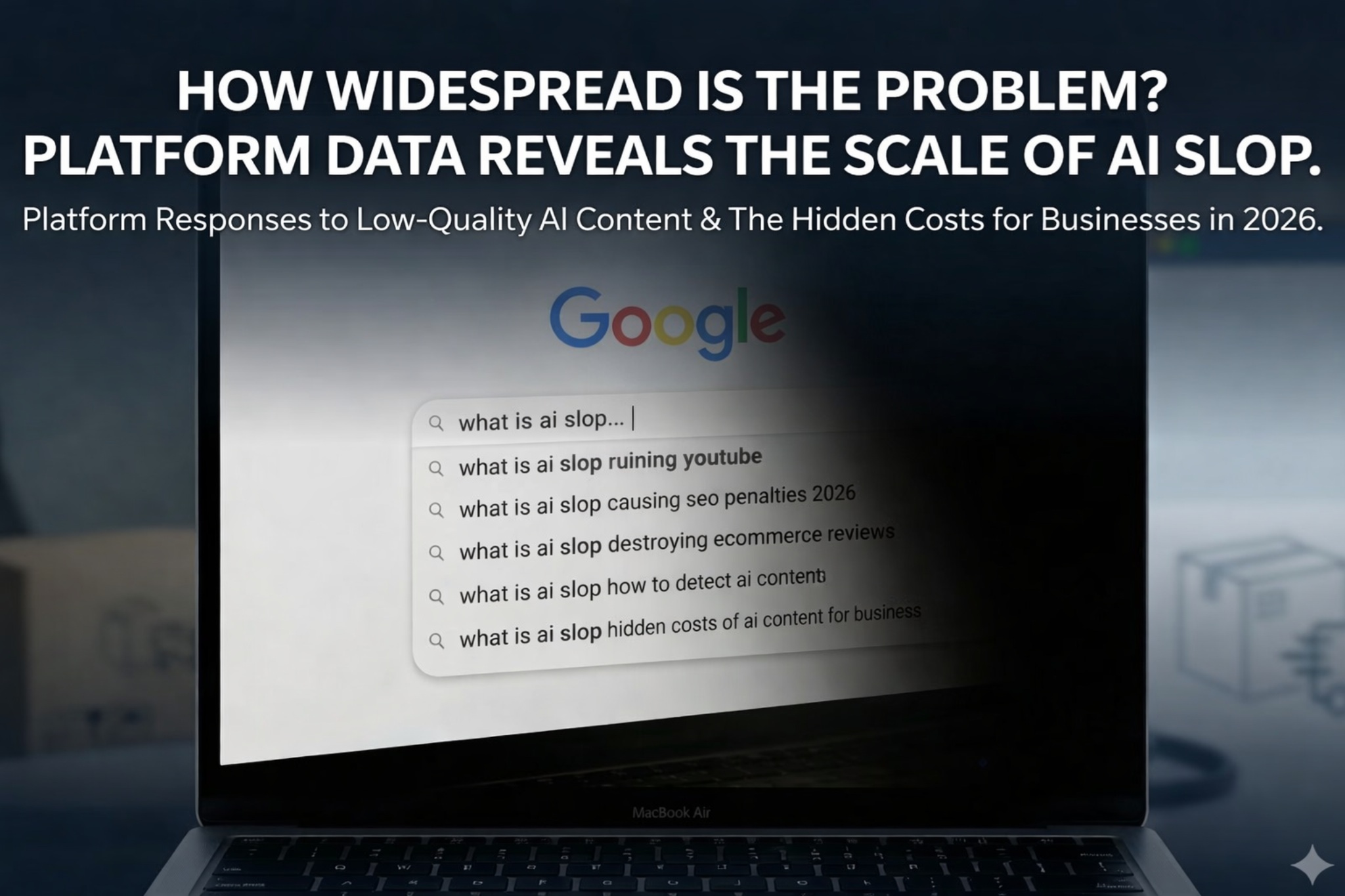
How Widespread Is the Problem? Platform Signals Point to a Bigger Shift
The exact scale varies by platform, but the direction is clear: more automated content is being produced than ever before. That creates a simple outcome. Users get more tired, trust drops faster, and platforms have to respond.
You can see the response in public policy updates and enforcement patterns across major platforms. Even when the details differ, the message is similar: repetitive, low-value content is becoming a liability.
YouTube's response: YouTube has become more aggressive about removing channels built on AI scripts, slideshows, and synthetic voices. The goal is not to ban AI. It is to reduce content that feels mass-produced and low-effort.
TikTok's crackdown: TikTok requires labeling of AI-generated content and creators report reach drops when content is flagged or feels overly synthetic.
eCommerce crisis: In eCommerce, the problem shows up in fake reviews, spam listings, and low-quality product pages. When shoppers cannot trust what they are seeing, conversion rates suffer and support costs rise.
The incentives behind this are obvious. Automated content is cheap to produce, easy to scale, and sometimes profitable in the short term. That creates a feedback loop where more people publish more content, which makes platforms tighten rules, which makes quality matter even more.
Why AI Slop Destroys Business Value: The Hidden Costs
When content feels artificial, trust drops. And once trust drops, everything gets harder. You pay more for traffic, your conversion rates soften, your email list grows slower, and your brand becomes easier to replace.
SEO Penalties and Ranking Decline
Google's spam policies and core updates are designed to reduce visibility for scaled content abuse. Using generative AI to publish many pages without adding real value can violate platform policies. Even when there is no formal penalty, generic content tends to create weak engagement signals, and rankings often fade over time.
Brand Differentiation Collapse
AI slop pushes brands into "content commoditization". When every company publishes the same advice with the same tone, no one stands out. That makes it harder to earn citations, mentions, and word-of-mouth.
User Experience Degradation
Readers can often sense when content is generic within seconds. When they bounce quickly, it sends a signal that the page did not deliver. Over time, that hurts both conversion and search performance.
The worst part is the pressure loop. When businesses see competitors publishing at scale, they feel forced to match volume. That is how quality standards collapse across an entire category.
Real eCommerce Examples: How AI Slop Hurts Bottom Lines
eCommerce is where the damage becomes easiest to measure. When shoppers do not trust what they see, they do not buy. And when they do buy based on misleading content, returns and support costs rise.
Product Description Spam
Many stores now publish AI-generated product descriptions that sound polished but do not answer real questions. The risk is not just boredom. It is inaccuracies, exaggerated claims, and higher refund rates when expectations are set incorrectly.
Review Manipulation at Scale
Fake reviews are not new, but automation makes them faster and cheaper to produce. That creates a trust crisis for marketplaces and brands. If shoppers assume reviews are unreliable, they delay purchases or choose the biggest brand by default.
UGC Flooding
Social platforms are full of AI-generated "unboxing" clips and product reviews that look real at first glance but contain no real experience. When shoppers notice, the brand association is negative, even if the brand did not create the content.
SEO Content Farms
Some brands publish thousands of pages targeting long-tail product keywords. In many cases, these pages do not help shoppers compare options, understand tradeoffs, or choose the right product. That is exactly the kind of content search engines are trying to reduce.
If your analytics show high impressions but weak engagement, it is often a sign that the content is being seen but not trusted. That is the early warning signal to fix quality before rankings slide.
How to Identify AI Slop: 7 Warning Signs Every Business Should Know
AI detectors can be useful as a rough signal, but they are not the best way to judge quality, especially when content is AI-assisted and then edited. A better approach is to look for human value signals. Here are seven warning signs that show up again and again.
- Generic corporate language: Phrases like "in today's digital landscape" or "game-changer" that could appear in any article.
- Repetitive structure: Every paragraph follows the same pattern, and every section feels like it was generated from a template.
- Lack of specific examples: Claims are made, but nothing is grounded in real situations.
- No original insight: The piece summarizes what everyone already knows, but adds no point of view.
- Unnatural keyword use: Keywords are forced into sentences instead of flowing naturally.
- Missing authority signals: No clear author, no experience, no proof that the writer has done the work.
- Perfect grammar, zero personality: Technically correct writing that feels sterile and interchangeable.
The fastest test is simple: does this page contain something that could only be written by someone who has actually done the work? If not, it is at risk of being treated as slop.
How Google and AI Search Engines Are Responding to AI Slop
Search engines are not standing still. Google has been clear that scaled content abuse is a problem, and recent updates increasingly reward content that shows experience and originality.
Recent updates tend to reward:
- Original research and data collection
- First-hand experience and clear examples
- Expert analysis that adds new thinking, not just summaries
- Helpful citations that support claims and guide readers
Meanwhile, content with slop patterns is more likely to be suppressed:
- Templated structures that feel mass-produced
- Generic advice without clear application
- Weak expertise signals and unclear authorship
- Large volumes of similar pages published quickly
It is also worth watching how AI search engines like Perplexity and ChatGPT choose what to cite. In many cases, they prefer content that includes unique data points, clear frameworks, and real expert analysis.
The FTC's updated review guidelines also signal that this is not only an SEO issue. In eCommerce, misleading reviews and synthetic endorsements can become a compliance risk.
As automated content increases, the advantage is no longer speed. The advantage is clarity, originality, and having something real to say.
AI Slop vs. Smart AI Workflows: The Difference That Builds Authority
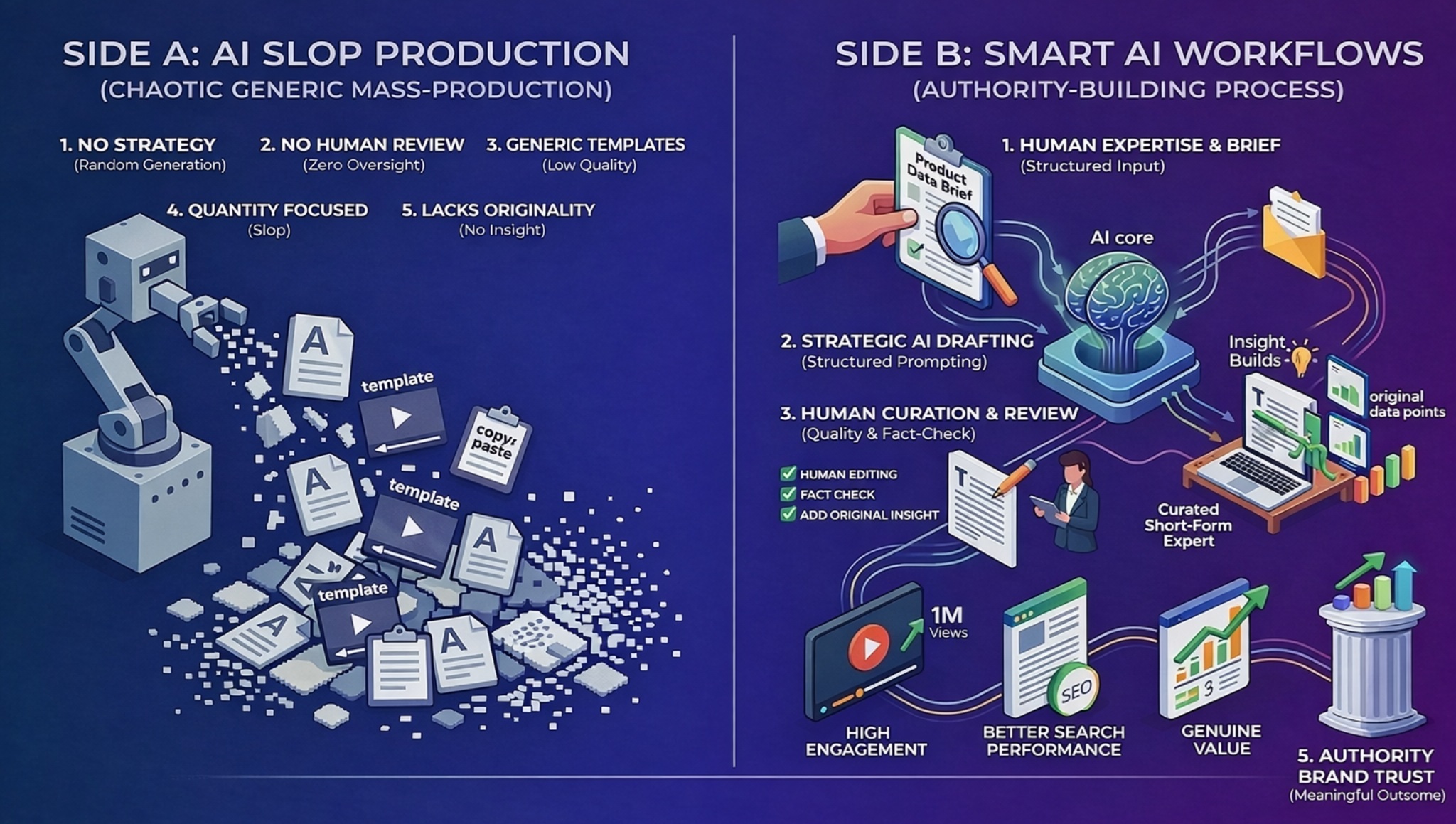
The goal is not to avoid AI. The goal is to use AI with structure. Smart workflows help humans move faster without losing judgment. Slop happens when the workflow is "generate and publish".
AI slop characteristics:
- Random generation without strategy
- No human oversight or editing
- Generic, templated outputs
- Mass production focused on quantity
- Zero original research or insights
Smart AI workflows:
- AI supports human expertise and research
- Structured prompts based on proven frameworks
- Human review, editing, and fact-checking
- Quality-focused content with thoughtful distribution
- Original insights, examples, and data that AI helps organize
The strongest teams use AI for research acceleration, outlining, and clarity. Then they add what AI cannot: real experience, real tradeoffs, and a point of view.
At SellerShorts, this distinction drives how we think about publishing and marketplaces. While the internet floods with generic AI slop, our curated AI Tools are designed with structured workflows that solve specific eCommerce problems. Every AI Tool in our marketplace goes through human review so it delivers real value instead of noise. The goal is simple: help businesses move faster without sacrificing trust.
If you want to build authority, treat AI like a power tool. It can speed up the work, but it cannot replace judgment. The brands that win are the ones that keep humans responsible for quality.
The Future of Content in an AI Slop World
AI slop is pushing the internet toward a two-tier reality. On one side, you have premium content with real editorial standards. On the other, you have oversaturated spaces filled with repetitive content competing for cheap attention.
Winning businesses choose their tier on purpose. They invest in expertise, original research, and a brand voice that feels human. They also build workflows that use AI to amplify those strengths, not replace them.
In practice, that means investing in:
- Subject matter expertise that cannot be copied by a template
- Original research and data that gives people a reason to cite you
- Brand voice that creates emotional connection and trust
- Strategic AI use that improves speed without lowering standards
Platforms are accelerating this split. TikTok suppresses unlabeled synthetic content. YouTube removes low-effort channels. Google rewards experience. The direction is clear: the more content floods the web, the more valuable real expertise becomes.
If you want a durable advantage, do not compete on volume. Compete on trust. Trust compounds.
Frequently asked questions
Can AI detectors accurately identify slop content?
AI detectors can help, but they are not a reliable judge on their own, especially when content is AI-assisted and then edited by a human. The most practical approach is to review for real-world specificity, first-hand experience, and whether the piece says anything your competitors could not publish in the same hour.
Is all AI-generated content considered slop?
No. AI slop is low-effort, mass-produced content that is published without real expertise, original thinking, or editorial oversight. AI can be used responsibly to speed up research, structure drafts, and improve clarity, as long as a human adds substance and checks accuracy.
How does AI slop affect search rankings and SEO?
Search engines are increasingly designed to reduce visibility for scaled, low-value pages. When content feels generic, users bounce, engagement drops, and rankings tend to follow. Content that demonstrates experience, specificity, and helpfulness is more likely to hold up over time.
What makes AI content high-quality versus slop?
High-quality AI-assisted content is built around a clear point of view, specific examples, and real expertise. It uses AI for speed, but keeps humans responsible for accuracy, originality, and usefulness. Slop is what happens when the goal is volume, not value.
Will AI slop continue growing in 2026?
AI-generated content will likely keep increasing because it is cheap and fast to produce. At the same time, platforms are tightening policies and ranking systems to reward originality and reduce repetitive content. The gap between trusted, expert content and mass-produced content is expected to keep widening.
AI Tools You Can Try
Build content that earns trust, not just clicks.
Browse AI Tools built specifically for eCommerce founders who want substance over slop.
Explore AI Tools →