 sellershorts
Why AI Product Photography Is Rapidly Changing How Amazon Sellers Create Images
High-quality imagery drives visibility and conversion on Amazon. AI image tools are reshaping how sellers create product photos, cutting cost and production time.

On this page
As competition increases on Amazon, high-quality product imagery has become essential for visibility and conversion. While most sellers scramble to understand listing requirements, a quiet revolution is reshaping how smart businesses approach product photography.
The numbers don't lie: 67% of consumers cite image quality as the biggest influence on their purchase decision (Designkit, 2026). Traditional photography pricing has pushed smaller sellers out and created bottlenecks for larger catalogs that need new images for every variant or seasonal refresh. For other AI workflows beyond photography, our AI tools marketplace has task-specific tools for the rest of an Amazon seller's workflow.
TL;DR: AI image tools cut per-image cost vs. a studio shoot and let you test new creative in minutes instead of weeks. Image quality drives conversion on Amazon, and the platform actively rewards compliant, high-resolution images. For most sellers, AI photography is worth trying as a hybrid alongside existing assets, not necessarily a full replacement.
What You Will Learn
- Why early-adopter Amazon sellers are moving to AI photography
- How traditional photography costs are killing profitability
- The conversion rate reality of image quality
- How Amazon prioritizes high-quality, compliant images
- Speed advantages that determine market share
- Consumer expectations driving industry shifts
Written by the SellerShorts editorial team, the AI tool marketplace for Amazon sellers. Some insights in this article are based on internal observations and feedback from SellerShorts users plus industry trend analysis.
What's driving Amazon sellers toward AI photography?
Adoption of AI photography tools is rising across ecommerce (Photoroom, 2026). For most sellers, the appeal is two practical things: faster turnaround and lower per-image cost. Quality has caught up enough that the output is usable for Amazon listings as long as you respect the platform's image rules.
High-quality, compliant images help shopper experience and can positively influence listing performance on Amazon.
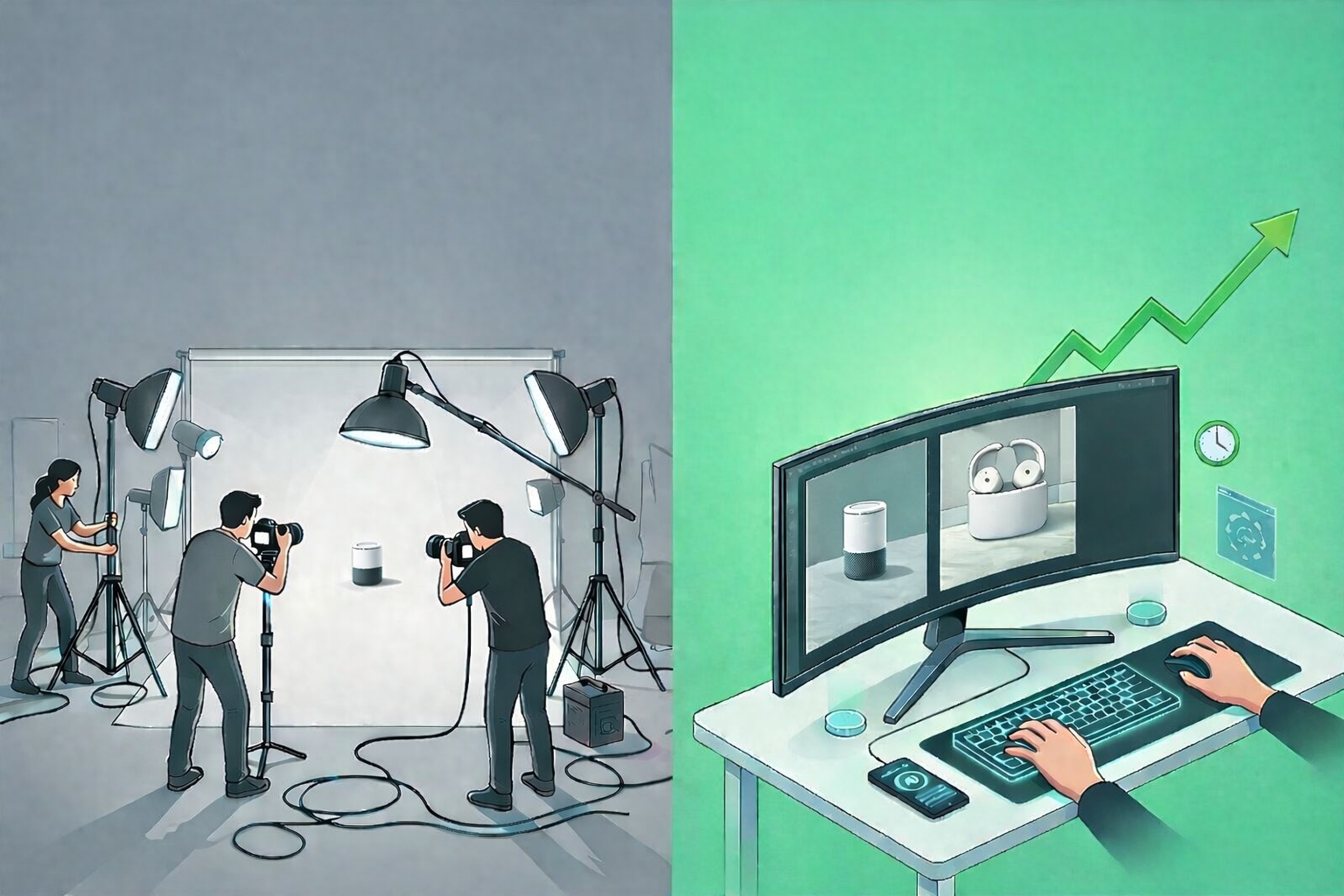
Where a traditional product shoot can take a few weeks (scheduling, location, model, multiple revisions), an AI workflow runs in minutes, useful when you're testing new angles, launching variants, or just trying to keep the catalog fresh without another freelance loop.
Our Amazon Image Generator builds the gallery from one clean product photo. Drop the SKU plus image and get a 7-image gallery (1 main hero plus 6 product tiles built around real buyer questions), pushed live to Seller Central in one click.
How Much Are Traditional Photography Costs Really Killing Profitability?
Professional product photography typically costs $15-50 per image, with a 100-product catalog running $35,000-42,000 when accounting for reshoots (Bridgeway Digital, 2025). These costs compound quickly for businesses with seasonal products, variant testing, or frequent catalog updates.
The hidden costs extend beyond initial photography. Traditional workflows involve:
- Location booking and setup fees
- Model hiring and coordination
- Multiple revision rounds
- Rush fees for urgent projects
- Storage and digital asset management
AI product photography platforms typically cut per-image production cost compared with traditional studio shoots, and turnaround drops from days to minutes. The exact savings depend on category, image volume, and how much editing your brand requires.
The Conversion Rate Reality: Why Image Quality Directly Impacts Revenue
High-quality product imagery is one of the strongest drivers of Amazon listing conversion (Adverio, 2026). The impact isn't just aesthetic, it's measurable. Listings with professional product images tend to outperform those with poor visuals.

The data becomes even more compelling when examining image quantity. Listings with multiple high-quality amazon images generally perform better than listings with limited visual information. For Amazon specifically, sellers should aim for 7 images per listing to maximize conversion potential without overwhelming shoppers.
Zoomable high-resolution images can improve shopper confidence and product understanding. This technical requirement alone eliminates many low-resolution options and drives sellers toward professional-quality solutions.
If you have a single product photo and need a full set of listing images, tools that take your ASIN and one upload can generate main, lifestyle, and detail shots in one go. Our Amazon Image Generator produces a 7-image pack built for Amazon standards, no design experience required, so you can go from one image to a conversion-ready gallery in minutes.
How to get Amazon-ready product images without a photoshoot
You don't need a studio booking, a model, or a freelancer to ship Amazon product images that meet the platform's standards. A clean transparent PNG of your product plus your ASIN is enough to generate a full set of Amazon images in minutes. The trade-off most sellers make today, paying $15-50 per shot or relying on amazon stock images that compete listings already use, is no longer the only option.
The practical workflow looks like this: upload one front-facing PNG, pick your marketplace, and let the tool generate the main image (pure-white background, label fully forward) plus 6 lifestyle and detail variants. The output is sized to Amazon's ≥1600px requirement so zoom works correctly, and the styling stays consistent across the set so the gallery reads as one brand rather than a patchwork of freelance shots.
One important call-out: amazon product images generated this way must still accurately represent the real product. Don't add features that don't exist or invent badges. The tool is faster than a studio, but the same Amazon listing policies apply to AI-generated images as to traditional photography. See the full breakdown of amazon image requirements for the exact specs Amazon enforces.
One more time-saver worth flagging: once the 7-image set is generated, the tool can push the entire pack directly to your connected Amazon listing in one click. No download, no Seller Central re-upload, no copy-paste juggling. For sellers running multiple ASINs, that's another 10-15 minutes saved per listing on top of the production cost reduction. And speaking of cost, if you're already feeling the margin squeeze on Amazon, fixing image quality is one of the cheapest ways to protect conversion, see our deeper read on why Amazon sellers are struggling with margin compression in 2026.
What Amazon's Image Standards Mean for Sellers
Amazon continues to prioritize listings with high-resolution, compliant images that improve shopper experience. The platform rewards imagery that meets technical and quality standards, regardless of how it was created.
Key expectations include:
- Minimum resolution standards that eliminate phone photography
- Color accuracy requirements that demand professional lighting
- Background consistency standards across image sets
- Technical specifications for zoom functionality
- Compliance with visual merchandising guidelines
As Amazon Ads adoption keeps growing, the cost of buying visibility goes up with it. That makes compliant, high-quality imagery a bigger competitive lever, organic conversion is the cheapest traffic you have, and image quality is the part you control.
The Hidden Speed Advantage: Why Time-to-Market Determines Market Share
Speed advantages compound across multiple business functions. Time is money in eCommerce.
- Product testing: Rapid image generation enables faster A/B testing of different visual approaches
- Seasonal adaptation: Quick creation of holiday or seasonal variants without reshoot costs
- Market expansion: Fast localization of imagery for different geographic markets
- Competitor response: Immediate visual updates in response to competitive moves
AI workflows shorten image production from weeks to hours, which makes it cheap to test new angles, variants, or seasonal creative without booking another shoot.
What Successful AI Photography Implementation Actually Looks Like
Many retailers report efficiency gains and faster content production after adopting AI tools (Shopify AI Statistics, 2026). However, success requires strategic implementation rather than tool adoption alone.
The most successful implementations follow a systematic approach:
Phase 1: Baseline Assessment
- Audit current image performance and conversion data
- Identify highest-impact products for initial testing
- Establish measurement frameworks for ROI tracking
Phase 2: Pilot Testing
- Start with 10-20 products to test AI-generated variants
- Run A/B tests comparing AI images to existing photos
- Measure conversion rate, click-through rate, and ad performance changes
Tools that help you test different image sets and measure what converts can make this pilot phase repeatable. You can find listing and conversion-focused tools in our marketplace to support this step.
Phase 3: Systematic Rollout
- Scale successful approaches across broader catalog
- Develop consistent style guidelines for brand coherence
- Train teams on efficient prompt engineering and quality control
Why Consumer Expectations Are Forcing the Industry Shift
67% of surveyed consumers expected brands to disclose when AI was used to create product pictures (Photoroom, 2026). This transparency expectation is driving higher quality standards rather than resistance to AI-generated content.
Consumer behavior data reveals specific expectations that traditional photography struggles to meet consistently. Modern buyers are sophisticated visual evaluators.
- Immediate visual comprehension: Products must be instantly understandable from thumbnail images
- Context-rich presentations: Lifestyle imagery that shows scale, use cases, and benefits
- Technical detail visibility: Zoom-capable images that reveal quality and craftsmanship
- Consistent brand presentation: Visual coherence across product lines and categories
Consumer expectations formed on Amazon increasingly influence behavior across all eCommerce platforms. Amazon captures 38% of U.S. eCommerce sales, making its visual standards the de facto industry benchmark that drives platform-wide pressure for professional imagery quality.
Amazon accounts for nearly 38% of all U.S. ecommerce sales (Industry Research, 2026). Consumer expectations formed on Amazon increasingly influence behavior across all eCommerce platforms, creating industry-wide pressure for professional imagery standards.
The Technical Infrastructure That's Making This Possible
The AI image generator market reached $2.1 billion in 2024 and is expected to grow to $8.9 billion by 2034, registering a 15.7% CAGR (Skyquest Technology, 2026). This rapid growth reflects massive infrastructure investments making AI photography accessible to mainstream businesses.
Current AI photography platforms have matured around a few specific capabilities:
- Advanced neural networks: Trained on millions of professional product images
- Contextual understanding: AI systems that recognize product categories and appropriate styling
- Brand consistency engines: Tools that maintain visual coherence across image sets
- Technical compliance automation: Built-in adherence to platform-specific requirements
AI photography platforms have improved turnaround times and brand control, with many tools now offering faster iteration and built-in compliance checks that traditional photography workflows often lack.
What the Next 18 Months Look Like for Amazon Sellers
Current usage among eCommerce shops remains moderate: 14% of ecommerce shops reported using AI for image manipulation or pattern recognition (Claid.ai, 2026). This represents a massive opportunity window for early adopters before the market becomes saturated with AI-enhanced listings.

Market dynamics strongly favor early adoption. The window is narrowing rapidly.
- Algorithm advantages: Sellers who improve listing quality early may gain a competitive advantage as standards continue to rise.
- Competitive differentiation: With most sellers still using stock or amateur photos, AI-generated images that follow real composition rules stand out
- Cost efficiency: Early implementation captures maximum ROI before competitors match image quality standards
- Learning curve advantages: Teams that develop AI photography expertise now will be better positioned for future tools
Adoption is expected to grow rapidly as tools become more accessible and cost-effective. Early adopters of professional AI-generated imagery can stand out while adoption is still moderate.
What this means for your next 12 months
Professional imagery has moved from optional to expected on Amazon. AI photography tools have matured to the point where the output is usable for most categories, the cost is lower, and the iteration speed is much faster than a traditional shoot.
Amazon continues to reward listings with high-resolution, compliant images. Combined with rising ad costs and tighter margins, that makes investing in image quality a high-ROI move, but only if you treat it as an experiment to measure, not a switch to flip.
The pragmatic next 12 months for most Amazon sellers looks like this:
- Audit first. Pull current CTR and conversion data on your existing images so you have a baseline.
- Pilot small. Run AI-generated images on 5-10 SKUs and A/B test against the existing set.
- Scale what works. Once a style consistently outperforms, roll it across the rest of the catalog.
- Keep checking the numbers. Conversion data, not vendor marketing, tells you whether AI imagery is earning its keep.
AI photography isn't a silver bullet, and most sellers will end up with a hybrid workflow, AI for the bulk of secondary images, custom shots for hero or category-specific moments. The honest pitch is faster iteration and lower per-image cost, not a guaranteed conversion win. Test before you commit.
If you want to try it, the Amazon Image Generator takes your ASIN and one clean product PNG, returns a 7-image pack sized to Amazon's standards, and can push the set live to your connected listing without a Seller Central re-upload.
Frequently asked questions
What size should Amazon product images be?
Amazon recommends a long-side dimension of at least 1600 pixels so the zoom feature works correctly on the product page. Square 2000×2000 is the safest default for the main image because it satisfies both the zoom rule and the platform's 85%-fill recommendation. Use sRGB color space and save as JPG, PNG, or TIFF.
Are AI-generated product images allowed on Amazon?
Yes, Amazon does not ban AI-generated product images. The platform's image standards focus on accuracy, resolution, and compliance with the main-image rules (pure white background, no text, no props). As long as the image represents the actual product honestly and meets the technical specs, how it was created does not matter to Amazon.
What's the realistic ROI timeline for switching to AI photography tools?
Some sellers report performance improvements within a few months after upgrading imagery quality, especially when combined with listing optimization.
Will Amazon penalize listings that use AI-generated product images?
Amazon focuses on image accuracy, resolution, and compliance. Images must represent the actual product regardless of how they are created.
What should I do with my existing professional product photos?
Existing professional photos can serve as valuable baseline assets for A/B testing against AI-generated alternatives. Many sellers find that hybrid approaches optimize both performance and budget allocation during the transition period.
AI Tools You Can Try
Turn one product photo into a full Amazon gallery.
Use AI Tools built for Amazon sellers to generate listing-ready imagery in minutes, not weeks.
Explore AI Tools →